An Honest Look at New Multi-Cancer Blood Tests
That question is becoming more common as tests such as Galleri® and CancerGuard® enter public awareness. Advertisements suggest that one blood draw may screen for dozens of cancers, including some that currently have no routine screening test.
The technology is promising, but the marketing
can make it sound more definitive than it is.
Can Cancer Be Identified With a Blood Test?
Many MCED tests analyze fragments of genetic material circulating in the bloodstream. These fragments are called cell-free DNA, or cfDNA. Both healthy cells and cancer cells release cell-free DNA (cfDNA) into the bloodstream.
However, cfDNA shed by cancer cells often carries distinct DNA and epigenetic patterns that may signal the presence of cancer.
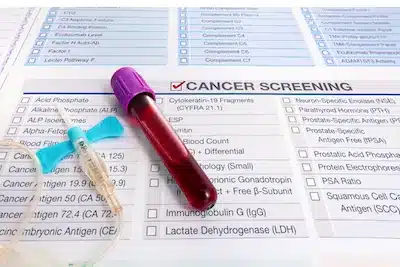
Some tests examine chemical changes known as methylation patterns. These patterns can function somewhat like a biological fingerprint, helping the test identify a possible cancer signal and estimate where in the body it may be coming from.
This is an important advancement because some cancers do not cause clear symptoms until later stages, and many do not have an established screening test. However, the National Cancer Institute emphasizes that MCED tests are still being studied to determine how effectively they find cancer and, most importantly, whether their use ultimately saves lives.

🔷 A negative result does not prove that cancer is absent.
An MCED test provides information that may justify further evaluation. It is not a stand-alone diagnosis.
Would Routine Blood Work Show Cancer?
Many patients assume that cancer would appear on their annual blood work. Unfortunately, routine tests were not designed for that purpose.
A comprehensive lab test will review your Complete Blood Count, or CBC, evaluates red blood cells, white blood cells, hemoglobin, and platelets. A Comprehensive Metabolic Panel, or CMP, provides information about liver function, kidney function, blood sugar, electrolytes, and protein levels.
Occasionally, these tests reveal abnormalities that require further investigation. Unexplained anemia might prompt an evaluation for gastrointestinal bleeding. Abnormal white blood cell counts could lead to testing for a blood disorder. Elevated liver enzymes might justify additional laboratory testing or imaging.
However, these findings are not specific to cancer. Many infections, medications, nutrient deficiencies, inflammatory conditions, and other non-cancerous problems can produce similar results.
At the same time, a patient with early-stage cancer may have completely normal routine blood work.
Normal laboratory results are not proof that cancer is absent,
and abnormal results do not automatically mean cancer is present.
MCED Tests Are Different From Tumor Markers
Tumor markers such as PSA, CA-125, CEA, and CA 19-9 measure substances that may become elevated with certain cancers. However, benign conditions can also elevate these markers, and some cancers produce no meaningful elevation at all.
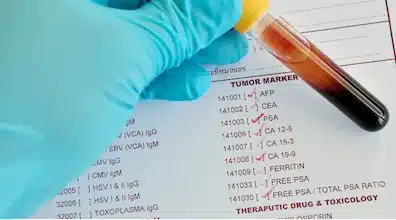
For that reason, many tumor markers are more useful for monitoring a known cancer, evaluating treatment response, or watching for recurrence than for broadly screening people without symptoms.
MCED tests generally look for cancer-associated signals in circulating genetic material rather than measuring one specific protein. The National Cancer Institute describes these tests as blood tests being studied to screen for several cancers at the same time by measuring biomarkers released into the blood.
Traditional Cancer Screening
✅ Usually targets one cancer
✅ Supported by established screening guidelines
✅ May directly visualize or sample abnormal tissue
✅ Can sometimes identify precancerous changes
✅ May lead directly to biopsy or treatment planning
MCED Blood Testing
✅ Looks for signals associated with multiple cancers
✅ Emerging technology with ongoing research
✅ Detects biological signals circulating in blood
✅ Does not generally identify or remove precancerous tissue
✅ Requires follow-up testing after a positive signal
The key point is that these approaches are not interchangeable.
A colonoscopy can identify and remove certain precancerous polyps. Imaging can show a suspicious breast lesion that can then be evaluated directly. An MCED test may suggest that a cancer signal is present, but it cannot show the physician exactly what is happening.
That is why MCED testing is generally considered an additional tool, not a substitute for established screening.
What About Galleri®, CancerGuard®, and Other Tests?
👉🏼 The number and types of cancers included
👉🏼 Their ability to predict the likely tissue of origin
👉🏼 Their published evidence
👉🏼 Their recommended follow-up process
Galleri, made by Grail, is intended to be used in addition to recommended cancer screening rather than as a replacement. It is generally positioned for people with an elevated cancer risk, including many adults aged 50 and older.
As of July 2026, MCED tests remain an evolving area of clinical medicine. The FDA has been actively evaluating appropriate study designs, benefits, risks, and regulatory standards for this category of testing.
Beyond the major direct-to-consumer tests, some integrative and precision oncology practices use additional cell-free DNA and circulating tumor cell technologies. BillionToOne’s Northstar ctDNA testing, for example, uses methodology that has published peer-reviewed validation, though it is newer to market and has a shorter track record than more established tests. Its role and appropriate use are still being defined.
Other panels, such as RGCC’s circulating tumor cell and chemosensitivity testing, are used by some integrative practices but sit outside mainstream oncology guidelines. Published, independent large-scale validation is limited, and these tests should not be considered equivalent in evidence quality to more established options. Any use of this kind of testing should happen in direct conversation with a physician who can explain what is and is not established about it.
This does not mean the technology has no value. It means patients should understand the difference between a commercially available laboratory test and a screening method that has already demonstrated a clear reduction in cancer deaths.
How Accurate Are Cancer Blood Tests?
There is no single accuracy number that applies to every MCED test or every cancer.
↪ The type of cancer
↪ The stage of the cancer
↪ How much tumor DNA enters the bloodstream
↪ The biomarkers and technology used
↪ The population being tested

Two terms are particularly important:
Sensitivity – describes how often a test correctly identifies cancer when cancer is truly present. Lower sensitivity means more cancers may be missed.
Specificity – describes how often a test correctly produces a negative result when cancer is not present. Lower specificity means more false-positive results.
A test can have high specificity and still miss a meaningful number of early cancers. This is why a negative result should never be used to dismiss persistent symptoms or skip routine screening.
A test can have high specificity and still miss a meaningful number of early cancers. This is why a negative result should never be used to dismiss persistent symptoms or skip routine screening.
It is also why “detects more than 50 cancers” does not mean “reliably detects every case of more than 50 cancers.”
What Happens After a Positive Result?
It does not end one.
Depending on the predicted tissue of origin, symptoms, medical history, and existing screening results, the next step may include:
🔷 Targeted laboratory testing
🔷 Referral to an oncologist or another specialist
🔷 Biopsy
🔷 Continued observation or repeat evaluation
Sometimes no cancer is found after follow-up. This is called a false positive. Even when the test itself is highly specific, false positives matter because they can lead to anxiety, expense, radiation exposure, invasive procedures, and additional appointments.
A positive result must therefore be interpreted thoughtfully, not treated as a diagnosis in isolation.

What Do These Tests Cost?
Most MCED testing remains self-pay, although coverage can vary by test, insurance plan, employer benefit, and individual eligibility. Pricing and coverage policies are changing, so patients should verify current information before ordering.
Cost is not the only consideration.
A more useful question is:
Will this result change what we do?
If neither a positive nor a negative result would meaningfully alter your screening, follow-up, or medical decision-making, the test may offer less value than expected.
At RHMC, we believe testing should be purposeful. More data is not automatically better care
Who May Benefit From a Conversation About MCED Testing?
Advanced cancer blood testing may be worth discussing for someone who:
☝🏼 Has a significant personal or family history of cancer
☝🏼 Has elevated risk based on age or other factors
☝🏼 Is current on recommended screening but wants to explore additional options
☝🏼 Understands the possibility of false-positive and false-negative results
☝🏼 Is prepared to complete appropriate follow-up testing
It may provide less value for a younger person at very low risk, someone expecting the test to replace routine screening, or someone who would not pursue the necessary follow-up after a positive result.
The decision should be individualized rather than driven by fear or advertising.
Why Physician Guidance Matters
At Regenerate Health Medical Center, we do not recommend advanced testing simply because it is available. Before ordering it, we consider your personal and family history, age, symptoms, environmental and lifestyle factors, previous screening, other laboratory findings, and overall health goals.

Sometimes MCED testing is a reasonable additional tool. Sometimes completing overdue imaging, colonoscopy, or other established screening is the more important next step. In other cases, the priority is addressing modifiable health risks while remaining attentive to symptoms and appropriate medical surveillance.
Dr. Aram is a member of the Oncology Association of Naturopathic Physicians and works alongside patients’ oncology teams as part of our naturopathic cancer support program — not as a replacement for oncology care. If you’re trying to make sense of a cancer blood test result, decide whether one is worth pursuing, or build a plan that complements your existing screening and treatment, that’s a conversation we’re glad to have.
Our goal is not to generate more laboratory reports. It is to ask better questions and help you make informed decisions as an active participant in your healthcare.
Final Thoughts
Blood-based cancer screening is one of the most compelling developments in preventive medicine. It may eventually help physicians detect cancers that currently lack routine screening options.
But promising does not mean perfect.
These tests can miss cancer, they can produce false alarms, and they have not replaced established screening. Their value depends on selecting the right patient, understanding the limitations, and having a clear plan for what comes next.
Technology will continue to evolve. New tests will come and go. What will not change is the importance of having a doctor who knows your history, understands your risks, and can help you interpret increasingly complex health information.
A laboratory result is data. Knowing what to do with that data is where clinical judgment matters.
If you are wondering whether advanced cancer blood testing belongs in your healthcare plan, the doctors at Regenerate Health Medical Center can help you evaluate the benefits, limitations, and appropriate next steps based on your individual risk profile and health goals.
Frequently Asked Question (FAQ)
Can cancer be identified with a blood test?
Answer: Yes, in a limited sense. Newer blood tests can detect signals associated with certain cancers, but they cannot diagnose cancer on their own, they can miss early disease, and they are not a substitute for established screening such as mammography, colonoscopy, or low-dose CT.
Would cancer show up in routine blood work?
Answer: Usually not. A standard CBC or metabolic panel can occasionally reveal a non-specific abnormality that prompts further testing, but these panels were not designed to detect cancer, and normal results do not rule it out.
What is an MCED test?
Answer: MCED stands for Multi-Cancer Early Detection. These tests look for biological signals — often fragments of cell-free DNA — that may be associated with cancer across multiple cancer types from a single blood draw. They are designed to complement standard screening, not replace it.
Is CancerGuard covered by Medicare?
Answer: Generally not yet. Congress has authorized Medicare reimbursement for multi-cancer detection tests beginning in 2028, contingent on FDA approval, but coverage isn’t in effect currently. Check with your specific plan for the most current answer.
How much does CancerGuard cost?
Answer: Most MCED tests remain self-pay today, with cost varying by test, provider, and any add-on panels. Pricing and coverage policies are changing quickly, so it’s worth confirming current cost directly with the lab before ordering.
How accurate is CancerGuard?
Answer: Accuracy varies by cancer type and stage, and figures come from the manufacturer’s own published data. As with any MCED test, a negative result does not rule out cancer, and a positive result requires follow-up to confirm.
Is the Galleri test covered by insurance?
Answer: Generally not for screening in average-risk adults, since it’s currently offered as a laboratory-developed test without full FDA approval. Coverage details vary by plan and should be confirmed directly with the insurer.
What is the difference between CancerGuard and Galleri?
Answer: Both are multi-cancer blood tests from different manufacturers, and they differ in the biomarkers analyzed, the cancers covered, the populations studied, and their published evidence. Neither is positioned here as better than the other — the right fit depends on your individual situation, which is worth discussing with a physician.
Are these tests FDA approved?
Answer: No MCED test currently holds full FDA approval. They operate as laboratory-developed tests, and at least one manufacturer has an application under FDA review as of mid-2026.
Can a blood test replace a colonoscopy or mammogram?
Answer: No. Established screening — mammography, colonoscopy, cervical cancer screening, and low-dose CT for eligible patients — remains the standard of care. MCED testing is an additional tool, not a substitute.
What are tumor markers, and are they the same thing?
Answer: No. Tumor markers like PSA, CA-125, and CEA measure a single substance and are typically used to monitor a known cancer or treatment response. MCED tests look for broader signals across multiple cancers and are generally used differently.
What happens if my result is positive?
Answer: A positive result starts an investigation, not a diagnosis. Depending on the predicted tissue of origin, next steps may include imaging, targeted lab testing, a specialist referral, or biopsy. Sometimes follow-up finds nothing — a false positive — which is still worth taking seriously through appropriate workup.
Do I need a doctor to order a cancer blood test?
Answer: Yes, both to order the test and — just as importantly — to interpret the result in the context of your personal history, risk factors, and existing screening. A result without that context can create more anxiety than clarity.
Is cancer blood testing right for everyone?
Answer: No. It tends to make the most sense for people with elevated risk who are already current on standard screening. For others, it may add cost and uncertainty without changing what happens next. This is a conversation worth having with a physician who knows your history.
Medical disclaimer: This article is provided for educational purposes only and is not a substitute for individualized medical advice, diagnosis, or treatment. Always consult a qualified healthcare professional about cancer screening, persistent symptoms, or medical testing.
Dr. Aram, NMD, is a licensed Naturopathic Medical Doctor at Regenerate Health Medical Center in Santa Barbara and a member of the Oncology Association of Naturopathic Physicians. His practice focuses on integrative and naturopathic support for patients navigating cancer risk, diagnosis, and survivorship, in coordination with each patient’s oncology team. Learn more about Dr. Aram.