Medically reviewed by Dr. Shayon Aram, ND — Last reviewed: August 25, 2026
Dr. Aram is a licensed Naturopathic Medical Doctor at Regenerate Health Medical Center in Santa Barbara, working with patients on gut health, hormones, metabolism, and chronic disease, with a particular focus on men's health and midlife wellness. He is a member of the California Naturopathic Doctors Association and the Oncology Association of Naturopathic Physicians, and provides adjunctive oncology care alongside conventional cancer treatment.
Parasites have been getting a lot of attention lately, and understandably so.
For many people, that brings up a bigger concern: Could something living in my gut be causing the symptoms I’ve been dealing with?
Standard parasite testing typically involves examining one or more stool samples to look for the parasite itself or its eggs.
Possibly. But that question only scratches the surface of what we can investigate.
A quick note: if you’re currently experiencing severe or sudden gastrointestinal symptoms, such as persistent vomiting, high fever, blood in your stool, or signs of dehydration, please seek prompt medical care or visit urgent care right away. The testing discussed below is for understanding ongoing or chronic gut symptoms, not a substitute for emergency evaluation of an active infection.
At Regenerate Health Medical Center, a comprehensive stool test may give our doctors information about parasites, bacteria, yeast, inflammation, immune activity, digestive function, absorption, and the overall microbial environment of the gut. Depending on the patient, we may also use breath testing, nutritional testing, hormone testing, or other functional labs to understand how those findings fit into the rest of the body.
That is very different from simply checking a stool sample for parasites.
The tests we choose are meant to help answer a
much bigger question:
WHY isn’t this person’s gut functioning the way it should?
RHMC offers several advanced gastrointestinal testing options from specialty laboratories including Doctor’s Data, ParaWellness, Vibrant America, Diagnostic Solutions Laboratory, and Genova Diagnostics. The specific test depends on what our doctor is trying to understand about that particular patient.
Parasite Testing Is Only One Piece of the Picture ☝🏼
If someone develops sudden severe gastrointestinal symptoms, suspected foodborne illness, or symptoms following a particular exposure or trip, looking specifically for an infectious organism may make sense.
But most of the patients who come through our doors are dealing with something much less straightforward.
Their story sounds more like:

“My stomach has been off for two years. I’m bloated all the time. Foods I used to eat bother me now. My energy is terrible, and I still don’t know why.”
They may have already changed their diet, taken probiotics, tried digestive enzymes, removed gluten, taken medications, or seen multiple providers.
That is where having an experienced Naturopathic Medical Doctor
who understands gut health can make a real difference.
Our doctors take the time to understand your symptoms, previous treatments, diet, medications, exposures, hormone changes, stress, bowel patterns, and other health concerns before deciding what testing will actually provide useful information.
Because more testing is not automatically better ☝🏼
Better Questions Lead To Better Testing ‼️
How Much Can a Comprehensive Gut Test Actually Show?
Inflammation: More Than One Number
Inflammation is one of the patterns our doctors want to understand because we can measure several different clues rather than simply guessing that someone has an “inflamed gut.”

The Doctor’s Data GI360, one of the comprehensive stool tests available through RHMC, is a good example. Its stool chemistry can provide as many as seven inflammation- and immune-related findings when we consider markers such as calprotectin, lactoferrin, lysozyme, white blood cells, mucus, secretory IgA, and occult blood. Calprotectin and lactoferrin in particular are well-studied markers for detecting intestinal inflammation and evaluating digestive function and the microbiome.
Those markers do not all tell us the same thing !
Calprotectin and lactoferrin can give us information about inflammatory activity. Secretory IgA gives us another window into the immune defenses lining the digestive tract. Other findings help our doctors see whether multiple pieces are pointing in the same direction.
That becomes especially valuable when someone is dealing with more than bloating. Maybe there are also food reactions, loose stools, fatigue, skin changes, nutrient deficiencies, joint discomfort, or other signs that the inflammatory picture may extend beyond digestion.
Together, those findings give us a clearer idea of whether inflammation may be contributing to the larger pattern and what deserves attention next.
Digestion: You Can Eat Well And Not Break Food Down Well
Nutrition matters, but eating healthy food does not guarantee that your body is digesting and absorbing it properly.
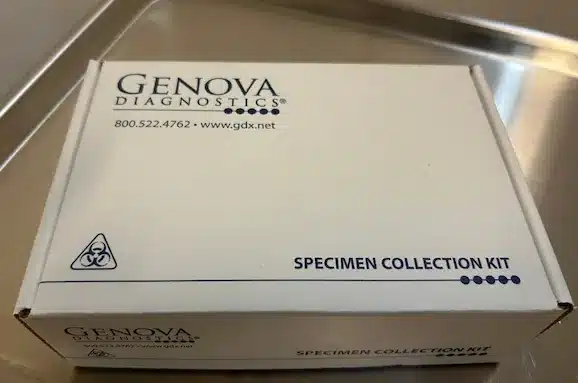
A test such as Genova Diagnostics’ GI Effects Comprehensive Profile can evaluate pancreatic elastase, fecal fat, and products of protein breakdown, giving our doctors information about pancreatic digestive function and how well fats and proteins are being handled. It also includes markers involving inflammation, immune activity, microbial ecology, and short-chain fatty acids.
That matters when someone tells us:
“I eat incredibly well. I take good supplements. Why do I still feel depleted?”
Sometimes the issue is not only what is going into the body. We need to understand what is happening to those nutrients after they get there. Poor digestion can help explain symptoms such as bloating, abnormal stools, discomfort after meals, and difficulty maintaining healthy nutrient levels.
Now we have something more useful to work with than another generic diet.
Your Microbiome Can Tell a Story:
Your digestive tract contains trillions of microorganisms, and that ecosystem is constantly interacting with your food, immune system, metabolism, intestinal lining, and the compounds produced inside the gut.

That microbial pattern can be surprisingly informative.
Sometimes it reflects diet. Certain beneficial organisms tend to thrive on diverse plant fibers and polyphenols. Repeated antibiotics, highly processed foods, alcohol, chronic stress, restricted diets, medications, and changes in digestive function can all influence the landscape.
Sometimes the microbiome also matches the symptom picture.
This can show us considerably more than whether one “bad bug” appears.
We may see low levels of organisms we want to support, over-representation of others, or a pattern consistent with dysbiosis, meaning the gut ecosystem has shifted out of a healthier balance.
Some of the individual organisms are fascinating too. Akkermansia muciniphila, for example, has attracted interest for its relationship with metabolic health. Research has even identified a protein produced by Akkermansia that stimulated the body’s own GLP-1 secretion in experimental models. Those are the kinds of connections that make microbiome testing useful.
The Doctor’s Data GI360, one of the comprehensive stool tests available through RHMC, is a good example. Its stool chemistry can provide as many as seven inflammation- and immune-related findings when we consider markers such as calprotectin, lactoferrin, lysozyme, white blood cells, mucus, secretory IgA, and occult blood. Calprotectin and lactoferrin in particular are well-studied markers for detecting intestinal inflammation and evaluating digestive function and the microbiome.
We are looking at what is thriving, what may be missing, what the diet may be encouraging, and how the overall pattern fits with digestion, inflammation, metabolism, and the patient’s symptoms.
Finding the Organism Is Only Half the Story
This is also where our Naturopathic approach to the idea of “infection” becomes different.
Microorganisms matter. If a parasite, pathogenic bacterium, or significant overgrowth is present, we pay attention to it.
But our doctors also want to understand the terrain that organism is living in.
Two people can be exposed to similar microbes and have very different experiences. Their immune resilience, microbial diversity, inflammatory burden, stomach acid, digestive enzymes, intestinal barrier, motility, nutritional status, stress physiology, medications, and overall health are not necessarily the same.
So when an organism becomes problematic, we ask more than how to get rid of it.
We also want to understand what changed in the gut environment that allowed it to gain a foothold.
Maybe repeated antibiotics dramatically altered the microbiome. Maybe digestion has been poor for years. Maybe inflammation is disrupting the intestinal environment. Maybe motility is slow. Maybe the mucosal immune system needs support.
Frequently, several of these factors overlap. That is the terrain.
At RHMC, treatment may involve addressing an organism directly when appropriate, but we also work on rebuilding the environment that allows a healthier ecosystem to take its place.
Otherwise, we may remove one problem without ever addressing why it developed.
Your Gut Symptoms May Not Stay in Your Gut
Gut health is about much more than digestion.
Your gastrointestinal system helps regulate nutrient availability, immune function, inflammation, metabolism, and the production and signaling of compounds that influence the brain, hormones, skin, and recovery. When that system is struggling, the effects may show up well beyond bloating or changes in bowel habits.

This is an important part of how our doctors at RHMC evaluate patients. We routinely work with people dealing with a wide range of concerns, not just digestive complaints.
That broader clinical experience helps us recognize when symptoms in seemingly unrelated parts of the body may actually be connected.
A patient may come in for bloating and also mention:
👉🏼 Low energy or poor exercise recovery
👉🏼 Brain fog, mood changes, or difficulty concentrating
👉🏼 Hormonal symptoms
👉🏼 Skin changes or recurring breakouts
👉🏼 Joint discomfort or increased inflammation
👉🏼 Difficulty maintaining iron, B12, or other nutrients
👉🏼 New food reactions
👉🏼 Changes in weight or metabolic health
Those additional symptoms matter ⚠️
The gut communicates constantly with the rest of the body. The gut-brain connection is one example, with intestinal microbes and their metabolites interacting with neurotransmitter and immune pathways involved in mood and cognition. The microbiome also participates in hormone metabolism, which is one reason gut health can become especially relevant for women navigating perimenopause and menopause.
Skin and recovery can provide clues too. Nutrient absorption, inflammatory signaling, immune balance, and the health of the intestinal barrier can all influence how well the body repairs tissue, manages inflammation, and maintains healthy skin.
This is why having a doctor who can look beyond the gastrointestinal tract matters. If we only focus on the bloating, we may miss the bigger pattern.
At RHMC, we can look at your gut findings alongside hormones, nutrient status, inflammation, metabolic health, symptoms, medications, diet, and medical history. That broader perspective often helps us connect pieces that have previously been treated as separate problems.
Symptoms are signals. Our job is to figure out what those signals are telling us.
At-Home Gut Health Kits vs. Clinician-Guided Testing
At-home gut health test kits have become easy to find. You order online, collect a sample, mail it back, and receive a report, often with colorful charts and a list of foods to avoid.
They can be a reasonable starting point, and for some people, simply seeing a snapshot of their gut microbiome is interesting on its own.
But convenience and interpretation are two different things.
An at-home kit can tell you what showed up in your sample. It generally cannot tell you why it matters for you specifically, whether it explains your symptoms, or what to actually do about it.
That is where clinician-guided testing works differently. When a Naturopathic Medical Doctor orders and reviews a comprehensive gut test, the results are not read in isolation. They are considered alongside your symptoms, health history, previous testing, medications, diet, and the rest of your clinical picture.
A few examples of where that difference matters:
👉🏼 A finding on an at-home report may look concerning on its own, but be unremarkable once your doctor factors in your diet or medication history.
👉🏼 A pattern that looks mild in isolation may be significant once connected to your specific symptoms.
👉🏼 Recommendations based purely on an algorithm may miss what is actually driving your particular case.
This does not mean at-home kits are without value. It means the report is a data point, not a diagnosis or a plan.
The real question is not “which test is best,” but “who is interpreting the results, and are they looking at my whole picture, or just the report?”
Getting Comprehensive Gut Testing in Santa Barbara
If you’re local to Santa Barbara and curious whether comprehensive gut testing makes sense for you, the process starts with a conversation, not a lab order.
At Regenerate Health Medical Center, one of our Naturopathic Medical Doctors will review your symptoms, history, and previous testing before recommending which panel actually fits your situation. Not every patient needs the same test, and not every patient needs a comprehensive panel at all.
From there, testing is straightforward: a stool kit you complete at home, results reviewed by your doctor, and a follow-up visit to walk through what the findings mean and what to do next.
Ready to find out what your gut is trying to tell you? Schedule a consultation with our Santa Barbara team to order a gut health test.
Frequently Asked Questions About Gut Testing
Can a stool test detect parasites?
Yes. A stool test can identify parasites, but a basic parasite screen only tells part of the story. A comprehensive stool test looks at parasites alongside bacteria, yeast, inflammation markers, and digestive function, giving a fuller picture of what may be affecting your gut.
How do I get tested for parasites?
Testing typically starts with a conversation about your symptoms and history so your doctor can recommend the right panel. At Regenerate Health Medical Center, this usually means an at-home stool collection kit followed by a review of results with one of our Naturopathic Medical Doctors.
What can a comprehensive gut test reveal besides parasites?
A comprehensive gut test can offer insight into inflammation, digestive function, nutrient absorption, and the balance of bacteria and yeast in the microbiome. These patterns can help explain symptoms like bloating, fatigue, and food reactions that go well beyond parasites alone.
Can I test my gut health at home?
At-home gut health kits are available and can offer a starting point. A clinician-guided test adds the interpretation piece, connecting your results to your symptoms, history, and the rest of your health picture, which an at-home kit alone typically doesn't provide.
What's the difference between a GI-MAP and a basic stool test?
A basic stool test typically screens for a limited set of organisms, most often parasites. A GI-MAP test is a more comprehensive stool analysis that evaluates beneficial bacteria, opportunistic organisms, yeast, parasites, and markers of digestion and immune activity in a single panel.
You Don’t Need Another Guess. You Need a Clearer Picture.
.
If you’ve been bouncing between diets, supplements, probiotics, antacids, cleanses, and conflicting advice, the answer may not be another product.
It may be finally understanding what your body is trying to tell you 🤓
At Regenerate Health Medical Center, our Naturopathic Medical Doctors use comprehensive histories, individualized laboratory testing, and a whole-person approach to help patients discover the WHY behind their symptoms.
Because once we understand what’s driving the pattern, we can stop throwing random solutions at it and start making more intentional decisions about your health.
Curious what your gut may be telling you? Schedule a consultation with our doctors at Regenerate Health Medical Center to find out whether comprehensive gut testing is the right next step for you.